
Your shopping cart is currently empty.
August 24, 2026 - Jet lag shown to wreak havoc on the gut microbiome in new review
August 24, 2026 Puzzle Piece
Jet lag shown to wreak havoc on the gut microbiome in new review
Many
experienced travelers grab a bottle of probiotics as they head out the
door for a trip. It's a great way to reinforce the body's first line of
defense against new bacteria they may be exposed to on their travels.
But there's another reason it may be a good idea to take probiotics when
traveling: it turns out the simple act of traveling through different
time zones wreaks havoc on the gut microbiome.
This means the gut microbiome will already be weakened even before
exposure to new strains of bacteria at the travel destination.
Study background
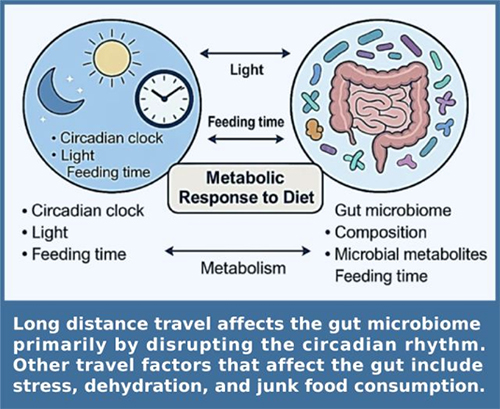
According to a new narrative review in the journal Nutrients, long-distance travel disrupts the body’s clock--and that disruption "scrambles the gut’s microbial community."
For
their review, which was published in May 2026, the researchers were
especially focused on athletes. The researchers noted that athletes are
"highly susceptible to circadian cycle and gut microbiome disturbances."
This "athlete risk" occurs because athletes are frequently traveling
across time zones. This contributes to regular jet lag, which, in turn,
impairs cognitive performance, sleep quality... and gut health.
Scientists even have a name for this problem: Gut jet lag.
The "gut jet lag" recipe
Trillions of gut microorganisms follow their own daily rhythms tied to
when a person eats and sleeps. When travel scrambles those patterns, the
microbial community gets scrambled too--manifesting into “gut jet lag.”
Evidence suggests that, in this situation, the gut lining becomes more
permeable--meaning bacteria and their byproducts could leak into the
bloodstream and trigger low-grade inflammation. Much previous
research--not related to travel--has already shown a link between poor
gut health and chronic inflammation.
Study highlights
To conduct the current study, the researchers conducted targeted,
non-systematic literature search using databases including PubMed,
Scopus, and Web of Science to identify relevant studies. The search
primarily focused on publications from 2016 to 2026, while earlier
seminal studies were included to provide essential physiological
context.
While the ultimate goal of the study was to determine how traveling
affected athletic performance, many of the studies reviewed did not
include athletes.
One study of 267 non-athlete travelers found gut microbial diversity
dropped in 61% of participants after their trip, particularly those who
used antibiotics.
A separate study on airline pilots found lower levels of beneficial
bacteria than in fitness instructors--though the researchers noted this
was a small observational study, not definitive proof.
How travel destroys the microbiome
Travelers with even a rudimentary knowledge of sleep patterns understand
that a master biological clock in the brain coordinates sleep and wake
cycles, hormone release, immune activity, and energy metabolism.
Additionally, organs like the liver and gut follow cues from light and
meal timing. When a traveler lands eight or nine time zones away, that
clock does not instantly reset, clinging to the old schedule while the
body tries to function on a new one. Scientists call this disruption
"circadian misalignment."
Besides the time shift itself affecting the gut, travel causes a number
of other "gut stressors": dehydration, travel stress, bouts of exertion,
increased junk food intake, and disrupted meal schedule.
All of these varied factors can reduce blood flow to the gut, which
strains the intestinal barrier. According to the researchers, this can
"push gut bacteria toward less beneficial states."

Moreover, this is just the time for sleep health to recover--gut health recovery is even longer.
The good news
The researchers noted that wise travelers can take steps to reduce the
severity of how travel affects the gut. Among the suggestions:
rehydration, timed bright-light exposure to reset the body clock,
probiotic and prebiotic supplementation, catch-up sleep, and fiber
intake.
SAVE THE DATE!
We have set the next Certification Seminar for November 5-7, 2026.
See you there!
|
|
Yours in Health and Wellness,
John W Brimhall, DC, BA, BS, FIAMA, DIBAK, Formulator, Patent Holder
6 Steps to Wellness Certification | November 5th - 7th, 2026
Dr. Brimhall's Six Steps to Wellness Protocol™ Will Include:
STRUCTURE
Step 1: Re-establish Structural Integrity, The Foundation of Health.
ELECTRICAL POLLUTION
Step 2: Rebalance Electromagnetics
NUTRITION
Step 3: Rebalance Nutrition
ALLERGIES AND SENSITIVITIES
Step 4: Reprogram the body for any Allergy or Sensitivity
EMOTIONS AND STRESS
Step 5: Re-evaluate Emotional Patterns & Remove Limiting Belief Systems
TOXICITY
Step 6: Remove Heavy Metals and Other Toxins from the Body
Price: $2,000.00 per person (only 20 seats available)
Seminar Location:
Dr. Brett Brimhall
2323 E. Guadalupe Rd. Suite 102 Gilbert, AZ 85234
Closest Hotel:
The Holiday Inn Express
5285 E. Baseline Rd Gilbert, AZ 85234
Hotel Phone: 480-218-8000
Call (866) 338-4883 to Register

Customer Reviews
