
Your shopping cart is currently empty.
March 9, 2026 - PARASITES - and A MUST EVAUATION AND THERAPY –

March 9, 2026 Puzzle Piece
PARASITES - and A MUST EVAUATION AND THERAPY –
Each
week I test patients with chronic pain and disability with my QI5
electrodermal assessment instrument. I have used 6 generations of
electrodermal testing and treating in my practice through the years.
The QI5 is the most advanced I have utilized. I screen each new patient
with it. We test/treat almost all of our patients with this device along
with utilizing all Six Steps To Wellness..
Recently, I listened to a podcast from two parasitologists this that demonstrated what I have been testing, treating, and teaching for most of my 55 years of practice. There are very few of us that do not have some type or types of parasite/s in us. Those of you that allow your dogs and/or cats sleep with you are almost certain to be infested. Some parasites come out the rectum of animals and night and seek out a new port of entry.

OHS’s Opti-Para is the most updated of the 4 generations of anti-parasitic I have formulated. It is the best of the best I have utilized. OHS also has a pearl of Black Seed Cumin Oil that is effective in parasites and Long Haul Covid. Together with the Opti-Para, we have seen previously almost hopeless cases turn around.
This parasite information is listed from the Wikipedia.
Clonorchis sinensis
21 languages
From Wikipedia, the free encyclopedia
We
are including much more than you may want to know, but I want you to
see a small part of the research that has been accomplished. Parasites are much more common and can cause many more health disasters than most people are aware of.
Clonorchis sinensis, the Chinese liver fluke, that belongs to the class Trematoda, phylum Platyhelminthes. It infects fish-eating mammals, including humans. In humans, it infects the common bile duct and gall bladder, feeding on bile. It was discovered by British physician James McConnell at the Medical College Hospital in Calcutta (Kolkata) in 1874. The first description was given by Thomas Spencer Cobbold, who named it Distoma sinense. The fluke passes its lifecycle in three different hosts, namely freshwater snail as first intermediate hosts, freshwater fish as second intermediate host, and mammals as definitive hosts.
Endemic to Asia and Russia, C. sinensis is the most prevalent human fluke in Asia and third-most in the world. It is still actively transmitted in Korea, China, Vietnam, and Russia. Most infections (about 85%) occur in China. The infection, called clonorchiasis, generally appears as jaundice, indigestion, biliary inflammation, bile duct obstruction, and even liver cirrhosis, cholangiocarcinoma, and hepatic carcinoma.
As a major causative agent of bile duct cancer, the International Agency for Research on Cancer has classified C. sinensis as a group 1 biological carcinogen in 2009.
Discovery
The symptoms of C. sinensis infection (clonorchiasis) have been known from ancient times in China. The earliest record is from corpses buried in 278 BC at Jiangling County of Hubei Province and the Warring States tomb of the western Han Dynasty. The parasite was discovered only in 1874, though, by James McConnell, a professor of pathology and resident physician at the Medical College Hospital in Calcutta. He recovered the fluke from a 20-year-old Chinese carpenter who died on 8 September 1874. On autopsy, he observed that the corpse had a swollen liver (hepatomegaly) and distended bile ducts, which he noted were blocked by "small, dark, vermicular-looking bodies." He recovered the vermicules (worms) and compared them with known flukes Fasciola hepatica and Distoma lanceolatum. He concluded that the new fluke was significantly different. He published his observations in the 21 August 1875 issue of The Lancet.
Description
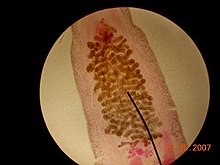
Clonorchis sinensis under a light microscope.
The eggs are similar to those of other related flukes such as Opisthorchis viverrini and O. felineus, and are often confused during diagnosis. They small and oval in shape, measuring about 30 x 15 μm in diameter. They are sharply curved and with a clear convex operculum towards the narrower end. At the broader end is a stem-shaped knob. The miracidium can be seen inside the fertilised egg.
Life cycle
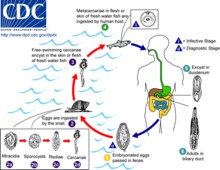
Lifecycle of C. sinensis
Production of eggs
The eggs of a C. sinensis are released through the biliary tract, and excreted out along with the faeces. The eggs are embryonated and contain the larvae called miracidia. Unlike most other flukes in which the miracidia undergo development and swim in water to infect suitable host, the eggs of C. sinensis are simply deposited in water. The eggs are then eaten by snails.
First intermediate host
Freshwater snail Parafossarulus manchouricus often serves as a first intermediate host.
Second intermediate host
When they detect fish, they attach themselves on the scales using their suckers. Boring their way into the fish's body, they penetrate into the fish muscle within 6 to 13 minutes. Within an hour of penetration, they develop hard coverings called cysts and become metacercariae. This protective cyst is useful when the fish muscle is consumed. The metacercariae gradually develop and become infective to their next hosts after 3 to 4 weeks.
Definitive host
Humans are the major definitive hosts. Infection occurs when raw or undercooked fish contaminated with the metacercariae is eaten. The cysts of the metacercariae are gradually digested by the human gastric acids, and upon reaching the small intestines, the entire cyst is lost. The free metacercariae penetrate the intestinal mucosa and enter the bile ducts. Migration into the bile ducts takes 1–2 days. They start feeding on the bile secreted from the liver, and gradually grow. They become adults in about a month, and start laying eggs. The average lifespan of an adult fluke is 30 years. An individual fluke can produce 4,000 eggs in a day.
Other definitive hosts are fish-eating mammals such as dogs, cats, rats, pigs,
Prevalence
C. sinensis is estimated to be the third-most prevalent worm parasite in the world. It is endemic to Russia, Japan, China,
The type of freshwater fishes and shrimp that are infected by C. sinensis contributes to the prevalence of infection. Commonly eaten fishes (e.g. C. idellus, C. auratus, H. nobilis, C. carpio, H. molitrix, and M. anguillicaudatus) were found to have the metacercariae when sampled from lakes, rivers, and markets. In total, almost 31 types of freshwater fish and shrimp were found to carry the parasite.
Effects on human health
Main article: Clonorchiasis
Dwelling in the bile ducts, C. sinensis induces an inflammatory reaction, epithelial hyperplasia, and sometimes even cholangiocarcinoma, the incidence of which is raised in fluke-infested areas.
One adverse effect of Clonorchis spp. is the possibility for the adult metacercaria to consume all bile created in the liver, which would inhibit the host human from digesting food, especially fats. Another possibility is obstruction of the bile duct by the parasite or its eggs, leading to biliary obstruction and cholangitis (specifically oriental cholangitis).
Unusual cases of liver abscesses due to clonorchiasis have been reported. Liver abscesses may be seen even without dilatation of intrahepatic bile ducts.
Symptoms
While normally asymptomatic, most pathological manifestations result from inflammation and intermittent obstruction of the biliary ducts. The acute phase consists of abdominal pain with associated nausea and diarrhea. Long-standing infections consist of fatigue, abdominal discomfort, anorexia, weight loss, diarrhea, and jaundice. The pathology of long-standing infections consist of bile stasis, obstruction, bacterial infections, inflammation, periductal fibrosis, and hyperplasia. Development of cholangiocarcinoma is progressive.
Diagnosis and treatment
Infection is detected mainly on identification of eggs by microscopic demonstration in faeces or in duodenal aspirate, but other sophisticated methods have been developed, such as ELISA, which has become the most important clinical technique. Diagnosis by detecting DNAs from eggs in faeces are also developed using PCR, real-time PCR, and loop-mediated isothermal amplification, which are highly sensitive and specific.
Typical imaging features center around imaging of the liver with CT, ultrasound, or MRI for detection of primary biliary cirrhosis. Traits that raise suspicion for the infection include intra- and extrahepatic dilatation and structures with intraductal pigmented stones, usually in the absence of gallstones and
References
We have set the next Certification Seminar for April 2026.
See you there!
Yours in Health and Wellness,
John W Brimhall, DC, BA, BS, FIAMA, DIBAK, Formulator, Patent Holder
Recently, I listened to a podcast from two parasitologists this that demonstrated what I have been testing, treating, and teaching for most of my 55 years of practice. There are very few of us that do not have some type or types of parasite/s in us. Those of you that allow your dogs and/or cats sleep with you are almost certain to be infested. Some parasites come out the rectum of animals and night and seek out a new port of entry.
OHS’s Opti-Para is the most updated of the 4 generations of anti-parasitic I have formulated. It is the best of the best I have utilized. OHS also has a pearl of Black Seed Cumin Oil that is effective in parasites and Long Haul Covid. Together with the Opti-Para, we have seen previously almost hopeless cases turn around.
This parasite information is listed from the Wikipedia.
Clonorchis sinensis
21 languages
From Wikipedia, the free encyclopedia
Clonorchis sinensis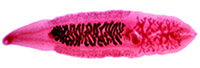 |
|
| An adult Clonorchis sinensis has these main body parts: oral sucker, pharynx, caecum, ventral sucker, vitellaria, uterus, ovary, Mehlis' gland, testes, excretory bladder. (H&E stain) | |
| Scientific classification | |
| Domain: | Eukaryota |
| Kingdom: | Animalia |
| Phylum: | Platyhelminthes |
| Class: | Trematoda |
| Order: | Plagiorchiida |
| Family: | Opisthorchiidae |
| Genus: | Clonorchis |
| Species: | C. sinensis |
| Binomial name Clonorchis sinensis Looss, 1907 |
|
Clonorchis sinensis, the Chinese liver fluke, that belongs to the class Trematoda, phylum Platyhelminthes. It infects fish-eating mammals, including humans. In humans, it infects the common bile duct and gall bladder, feeding on bile. It was discovered by British physician James McConnell at the Medical College Hospital in Calcutta (Kolkata) in 1874. The first description was given by Thomas Spencer Cobbold, who named it Distoma sinense. The fluke passes its lifecycle in three different hosts, namely freshwater snail as first intermediate hosts, freshwater fish as second intermediate host, and mammals as definitive hosts.
Endemic to Asia and Russia, C. sinensis is the most prevalent human fluke in Asia and third-most in the world. It is still actively transmitted in Korea, China, Vietnam, and Russia. Most infections (about 85%) occur in China. The infection, called clonorchiasis, generally appears as jaundice, indigestion, biliary inflammation, bile duct obstruction, and even liver cirrhosis, cholangiocarcinoma, and hepatic carcinoma.
As a major causative agent of bile duct cancer, the International Agency for Research on Cancer has classified C. sinensis as a group 1 biological carcinogen in 2009.
Discovery
The symptoms of C. sinensis infection (clonorchiasis) have been known from ancient times in China. The earliest record is from corpses buried in 278 BC at Jiangling County of Hubei Province and the Warring States tomb of the western Han Dynasty. The parasite was discovered only in 1874, though, by James McConnell, a professor of pathology and resident physician at the Medical College Hospital in Calcutta. He recovered the fluke from a 20-year-old Chinese carpenter who died on 8 September 1874. On autopsy, he observed that the corpse had a swollen liver (hepatomegaly) and distended bile ducts, which he noted were blocked by "small, dark, vermicular-looking bodies." He recovered the vermicules (worms) and compared them with known flukes Fasciola hepatica and Distoma lanceolatum. He concluded that the new fluke was significantly different. He published his observations in the 21 August 1875 issue of The Lancet.
Description
Clonorchis sinensis under a light microscope.
The eggs are similar to those of other related flukes such as Opisthorchis viverrini and O. felineus, and are often confused during diagnosis. They small and oval in shape, measuring about 30 x 15 μm in diameter. They are sharply curved and with a clear convex operculum towards the narrower end. At the broader end is a stem-shaped knob. The miracidium can be seen inside the fertilised egg.
Life cycle
Lifecycle of C. sinensis
Production of eggs
The eggs of a C. sinensis are released through the biliary tract, and excreted out along with the faeces. The eggs are embryonated and contain the larvae called miracidia. Unlike most other flukes in which the miracidia undergo development and swim in water to infect suitable host, the eggs of C. sinensis are simply deposited in water. The eggs are then eaten by snails.
First intermediate host
Freshwater snail Parafossarulus manchouricus often serves as a first intermediate host.
Second intermediate host
When they detect fish, they attach themselves on the scales using their suckers. Boring their way into the fish's body, they penetrate into the fish muscle within 6 to 13 minutes. Within an hour of penetration, they develop hard coverings called cysts and become metacercariae. This protective cyst is useful when the fish muscle is consumed. The metacercariae gradually develop and become infective to their next hosts after 3 to 4 weeks.
Definitive host
Humans are the major definitive hosts. Infection occurs when raw or undercooked fish contaminated with the metacercariae is eaten. The cysts of the metacercariae are gradually digested by the human gastric acids, and upon reaching the small intestines, the entire cyst is lost. The free metacercariae penetrate the intestinal mucosa and enter the bile ducts. Migration into the bile ducts takes 1–2 days. They start feeding on the bile secreted from the liver, and gradually grow. They become adults in about a month, and start laying eggs. The average lifespan of an adult fluke is 30 years. An individual fluke can produce 4,000 eggs in a day.
Other definitive hosts are fish-eating mammals such as dogs, cats, rats, pigs,
Prevalence
C. sinensis is estimated to be the third-most prevalent worm parasite in the world. It is endemic to Russia, Japan, China,
The type of freshwater fishes and shrimp that are infected by C. sinensis contributes to the prevalence of infection. Commonly eaten fishes (e.g. C. idellus, C. auratus, H. nobilis, C. carpio, H. molitrix, and M. anguillicaudatus) were found to have the metacercariae when sampled from lakes, rivers, and markets. In total, almost 31 types of freshwater fish and shrimp were found to carry the parasite.
Effects on human health
Main article: Clonorchiasis
Dwelling in the bile ducts, C. sinensis induces an inflammatory reaction, epithelial hyperplasia, and sometimes even cholangiocarcinoma, the incidence of which is raised in fluke-infested areas.
One adverse effect of Clonorchis spp. is the possibility for the adult metacercaria to consume all bile created in the liver, which would inhibit the host human from digesting food, especially fats. Another possibility is obstruction of the bile duct by the parasite or its eggs, leading to biliary obstruction and cholangitis (specifically oriental cholangitis).
Unusual cases of liver abscesses due to clonorchiasis have been reported. Liver abscesses may be seen even without dilatation of intrahepatic bile ducts.
Symptoms
While normally asymptomatic, most pathological manifestations result from inflammation and intermittent obstruction of the biliary ducts. The acute phase consists of abdominal pain with associated nausea and diarrhea. Long-standing infections consist of fatigue, abdominal discomfort, anorexia, weight loss, diarrhea, and jaundice. The pathology of long-standing infections consist of bile stasis, obstruction, bacterial infections, inflammation, periductal fibrosis, and hyperplasia. Development of cholangiocarcinoma is progressive.
Diagnosis and treatment
Infection is detected mainly on identification of eggs by microscopic demonstration in faeces or in duodenal aspirate, but other sophisticated methods have been developed, such as ELISA, which has become the most important clinical technique. Diagnosis by detecting DNAs from eggs in faeces are also developed using PCR, real-time PCR, and loop-mediated isothermal amplification, which are highly sensitive and specific.
Typical imaging features center around imaging of the liver with CT, ultrasound, or MRI for detection of primary biliary cirrhosis. Traits that raise suspicion for the infection include intra- and extrahepatic dilatation and structures with intraductal pigmented stones, usually in the absence of gallstones and
References
- Yoshitaka,
Komiya (1967). "Clonorchis and clonorchiasis". In Dawes, Ben
(ed.). Advances in Parasitology Volume 4. Burlington: Elsevier.
pp. 53–101. ISBN 978-0-08-
058050-0. - Wu
W, Qian X, Huang Y, Hong Q (2012). "A review of the control
of Clonorchiasis sinensis and Taenia solium taeniasis/cysticercosis in
China". Parasitology Research. 111 (5): 1879–1884. doi:10.1007/s00436-
012-3152-y. PMID 23052782. S2CID 14136962. - Hong, Sung-Tae; Fang, Yueyi (2012). "Clonorchis sinensis and clonorchiasis, an update". Parasitology International. 61 (1): 17–24. doi:10.1016/j.parint.
2011.06.007. PMID 21741496. - Hong ST, Fang Y (2012). "Clonorchis sinensis and clonorchiasis, an update". Parasitology International. 61 (1): 17–24. doi:10.1016/j.parint.
2011.06.007. PMID 21741496. - Sripa
B, Brindley PJ, Mulvenna J, Laha T, Smout MJ, Mairiang E, Bethony JM,
Loukas A (2012). "The tumorigenic liver fluke Opisthorchis
viverrini--multiple pathways to cancer". Trends in Parasitology. 28 (10): 395–407. doi:10.1016/j.pt.
2012.07.006. PMC 3682777. PMID 22947297. - American Cancer Society (2013). "Known and Probable Human Carcinogens". cancer.org. American Cancer Society, Inc. Archived from the original on 2014-11-17. Retrieved 2013-06-02.
- Qian, Men-Bao; Utzinger, Jürg; Keiser, Jennifer; Zhou, Xiao-Nong (2016). "Clonorchiasis". The Lancet. 387 (10020): 800–810. doi:10.1016/S0140-
6736(15)60313-0. PMID 26299184 . S2CID 208794050. - Yoshida,
Yukio (2012). "Clonorchiasis—A historical review of contributions of
Japanese parasitologists". Parasitology International. 61 (1): 5–9. doi:10.1016/j.parint.
2011.06.003. PMID 21749930. - Sripa,
Banchob; Tesana, Smarn; Yurlova, Natalia; Nawa, Yukifumi (2017). "A
historical review of small liver fluke infections in
humans". Parasitology International. 66 (4): 337–340. doi:10.1016/j.parint.
2017.01.004. PMID 28069407. - Kim,
TS; Pak, JH; Kim, JB; Bahk, YY (2016). "Clonorchis sinensis, an
oriental liver fluke, as a human biological agent of cholangiocarcinoma:
a brief review". BMB Reports. 49 (11): 590–597. doi:10.5483/BMBRep.
2016.49.11.109. PMC 5346318. PMID 27418285. - Adams,
Ann M. (2006). "Foodborne trematodes". In Ortega, Ynes R.
(ed.). Foodborne Parasites. New York: Springer Science+Business Media.
pp. 168–173. ISBN 978-0-387-
31197-5. - Bogitsh,
Burton Jerome; Carter, Clint Earl; Oeltmann, Thomas N. (2005). Human
Parasitology (3 ed.). Amsterdam: Elsevier Academic Press.
pp. 207–210. ISBN 978-0-12-
088468-1. - Ridley,
John W. (2012). Parasitology for Medical and Clinical Laboratory
Professionals. Clifton Park, N.Y.: Delmar. pp. 187–188. ISBN 978-1-4-
3544816-2. - Clonorchis sinensis Archived 2008-03-17 at the Wayback Machine. Web Atlas of Medical Pathology, accessed 1 April 2009
- World Health Organization (1995). Control of Foodborne Trematode Infection. WHO Technical Report Series. 849. PDF part 1, PDF part 2. page 125-126.
- Hung,
Nguyen; Dung, Do; Lan Anh, Nguyen; Van, Phan; Thanh, Bui; Van Ha,
Nguyen; Van Hien, Hoang; Canh, Le (2015). "Current status of fish-borne
zoonotic trematode infections in Gia Vien district, Ninh Binh province,
Vietnam". Parasites & Vectors. 8 (1): 21. doi:10.1186/s13071-015-
0643-6. PMC 4299372. PMID 2558 6313. - Tang,
Ze-Li; Huang, Yan; Yu, Xin-Bing (2016). "Current status and
perspectives of Clonorchis sinensis and clonorchiasis: epidemiology,
pathogenesis, omics, prevention and control". Infectious Diseases of
Poverty. 5 (1): 71. doi:10.1186/s40249-016-
0166-1. PMC 4933995. PMID 2738 4714. - Chai
JY, Darwin Murrell K, Lymbery AJ (2005). "Fish-borne parasitic
zoonoses: Status and issues". International Journal for Parasitology. 35 (11–12): 1233–1254. doi:10.1016/j.
ijpara.2005.07.013. PMID 16143 336. - Sohn,
Woon-Mok (2009). "Fish-borne zoonotic trematode metacercariae in the
Republic of Korea". The Korean Journal of Parasitology. 47 (Suppl): S103-113. doi:10.3347/kjp.
2009.47.S.S103. PMC 2769214. PMID 19885326. - Fattakhov, RG; Ushakov, AV; Stepanova, TF; Ianovich, VA; Kopylov, PV (2012). "Epizootiological characteristics of clonorchiasis foci in the Amur River ecosystem in the Jewish autonomic region". Meditsinskaia Parazitologiia I Parazitarnye Bolezni (4): 15–18. PMID 23437716.
- Kim,
Jae-Hwan; Choi, Min-Ho; Bae, Young Mee; Oh, Jin-Kyoung; Lim, Min Kyung;
Hong, Sung-Tae; Ito, Akira (2011). "Correlation between Discharged
Worms and Fecal Egg Counts in Human Clonorchiasis". PLOS Neglected
Tropical Diseases. 5 (10): e1339. doi:10.1371/journal.
pntd.0001339. PMC 3186755. PMID 21991401. - Tang,
Ze-Li; Huang, Yan; Yu, Xin-Bing (2016). "Current status and
perspectives of Clonorchis sinensis and clonorchiasis: epidemiology,
pathogenesis, omics, prevention and control". Infectious Diseases of
Poverty. 5 (1): 71. doi:10.1186/s40249-016-
0166-1. PMC 4933995. PMID 2738 4714. - Kumar et al.: Robbins & Cotran Pathologic Basis of Disease 7E
- Jang,
Yun-Jin; Byun, Jae Ho; Yoon, Seong Eon; Yu, EunSil
(2007-01-01). "Hepatic Parasitic Abscess Caused by Clonorchiasis:
Unusual CT Findings of Clonorchiasis". Korean Journal of Radiology. 8 (1): 70–73. doi:10.3348/kjr.2007.8.
1.70. ISSN 1229-6929. PMC 2626 702. PMID 17277566. - Dr. Kuo, O. Sinensis Lecture, ATSU School of Osteopathic Medicine Arizona, June 2012
- Park,
MS; Yu, JS; Kim, KW; Kim, MJ; Chung, JP; Yoon, SW; Chung, JJ; Lee, JT;
Yoo, HS (September 2001). "Recurrent pyogenic cholangitis: comparison
between MR cholangiography and direct cholangiography". Radiology. 2
20 (3): 677–82. doi:10.1148/radiol. 2202001252. PMID 11526266. - Xu LL, Xue J, Zhang YN, Qiang HQ, Xiao SH (2011). "In vitro effect of seven anthelmintic agents against adult Clonorchis sinensis". Zhongguo Ji Sheng Chong Xue Yu Ji Sheng Chong Bing Za Zhi. 29 (1): 10–15. PMID 21823316.
- Park,
Gab-Man; Im, Kyung-il; Huh, Sun; Yong, Tai-Soon (2000). "Chromosomes of
the liver fluke, Clonorchis sinensis". The Korean Journal of
Parasitology. 38 (3): 201–6. doi:10.3347/kjp.2000.
38.3.201. PMC 2728209. PMID 11 002660. - Wang,
Xiaoyun; Chen, Wenjun; Huang, Yan; Sun, Jiufeng; Men, Jingtao; Liu,
Hailiang; Luo, Fang; Guo, Lei; et al. (2011). "The draft genome of the
carcinogenic human liver fluke Clonorchis sinensis". Genome Biology. 12 (10): R107. doi:10.1186/gb-2011-12-
10-r107. PMC 3333777. PMID 220 23798. - Huang,
Yan; Chen, Wenjun; Wang, Xiaoyun; Liu, Hailiang; Chen, Yangyi; Guo,
Lei; Luo, Fang; Sun, Jiufeng; Mao, Qiang; Liang, Pei; Xie, Zhizhi; Zhou,
Chenhui; Tian, Yanli; Lv, Xiaoli; Huang, Lisi; Zhou, Juanjuan; Hu, Yue;
Li, Ran; Zhang, Fan; Lei, Huali; Li, Wenfang; Hu, Xuchu; Liang, Chi;
Xu, Jin; Li, Xuerong; Yu, Xinbing; Ralph, Stuart Alexander (30 January
2013). "The Carcinogenic Liver Fluke, Clonorchis sinensis: New Assembly,
Reannotation and Analysis of the Genome and Characterization of Tissue
Transcriptomes". PLOS ONE. 8 (1): e54732. Bibcode:2013PLoSO...
854732H. doi:10.1371/journal. pone.0054732. PMC 3559784. PMID 23382950.
We have set the next Certification Seminar for April 2026.
See you there!
Yours in Health and Wellness,
John W Brimhall, DC, BA, BS, FIAMA, DIBAK, Formulator, Patent Holder
6 Steps to Wellness Certification | April 9th - 11th, 2026
Dr. Brimhall's Six Steps to Wellness Protocol™ Will Include:
STRUCTURE
Step 1: Re-establish Structural Integrity, The Foundation of Health.
ELECTRICAL POLLUTION
Step 2: Rebalance Electromagnetics
NUTRITION
Step 3: Rebalance Nutrition
ALLERGIES AND SENSITIVITIES
Step 4: Reprogram the body for any Allergy or Sensitivity
EMOTIONS AND STRESS
Step 5: Re-evaluate Emotional Patterns & Remove Limiting Belief Systems
TOXICITY
Step 6: Remove Heavy Metals and Other Toxins from the Body
Price: $2,000.00 per person (only 20 seats available)
Seminar Location:
Dr. Brett Brimhall
2323 E. Guadalupe Rd. Suite 102 Gilbert, AZ 85234
Closest Hotel:
The Holiday Inn Express
5285 E. Baseline Rd Gilbert, AZ 85234
Hotel Phone: 480-218-8000
Call (866) 338-4883 to Register
Customer Reviews
